Carole MacMullan has lived in Georgia for 17 years and seen exactly three adult luna moths. The former biology teacher and North Fulton Master Gardener says that scarcity is precisely what makes a sighting special.
"If you had a moth beauty pageant, the luna moth would win out hands-down, in my estimation," MacMullan wrote in her Garden Buzz column published Monday, July 21.
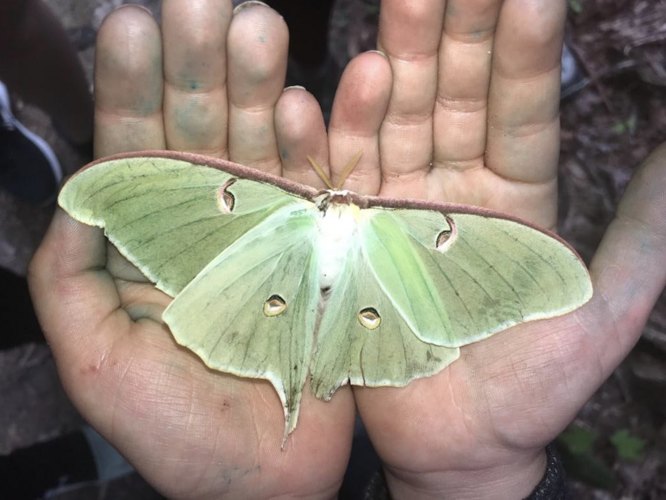
The luna moth is one of North America's largest moths, with pale green wings spanning 3 to 5 inches and distinctive elongated tail extensions. In Georgia, the species is active from March through September and can produce three broods per year, according to MacMullan's column in Appen Media. Sandy Springs residents can still look for them through the end of summer.
What grows here feeds them
The trees luna moth caterpillars depend on are already standing in many Sandy Springs yards. Females lay 200 to 400 tiny, brown-and-white-speckled eggs on the leaves of walnut, sweetgum, hickory, persimmon, sumac, and birch trees. All six species are common across North Fulton.
The bright green caterpillars, marked by a yellow line running the length of their bodies, eat constantly for two to three weeks before turning reddish-orange and spinning cocoons. About three weeks later, an adult moth emerges.
A week to live
Here's the catch: adult luna moths have no mouthparts. They cannot eat. Once they emerge from the cocoon, pump blood into their wings to unfurl them, and hang upside-down while the veins harden, they have seven to 10 days to find a mate and reproduce before dying.
MacMullan saw her first Georgia luna moth on a porch in Hiawassee in early August. It was barely moving, already in its final hours.
Built-in defenses
Those striking wings aren't just for show. The pale green color camouflages the moth against tree bark and leaf litter. Eyespots on all four wings confuse predators or redirect attacks away from the body. The elongated tail extensions can disrupt a bat's echolocation, and bats are the luna moth's primary predator, according to MacMullan.
Her advice for residents: don't touch a live luna moth's wings. Rubbing off the powdery scales can impair its ability to fly, regulate body temperature, and hide from predators.
How to spot one
MacMullan recommends a spring or summer evening walk. Look on the shady side of host trees: walnut, sweetgum, hickory, persimmon, sumac, or birch. Luna moths are nocturnal, so dusk and after dark offer the best chances.
Residents who want to learn more from the North Fulton Master Gardeners can find them frequently at the Sandy Springs Farmers Market on Saturdays. The group also runs Little Diggers, a free family gardening series for children ages 6 to 10, at the market through October. More information is available at nfmg.net.